WHO
The Masterless Body
The bioacoustic force of the scream does not determine the social form through which it is executed. That form must be constructed through the relations among the individual , the local , the available modes of execution, and the global network of Members. Against cephalic command structures and cardiocentric hierarchies, Lingua Membra develops a masterless body politic: a body without a head, heart, sovereign, lawgiver, priest, party, or any other .
is the rupture left within the body; through voice, breath, aperture, trace, and public address, the gives public form without claiming to reproduce that rupture. In this adapted sense, what is most intimate to the subject appears exterior through the Wound. When the Wound is encircled, this extimate structure takes material form. here is not sacred geometry, nor the demand for a perfect ring. It is the structured holding-open of the linguistic void: the act by which the Wound is given a fragile perimeter without being cured, interpreted, or closed. This perimeter may be carried by a solitary Fibre, a dyad, a trio, an arc, a line, a ring, a mass formation, or a distant answering execution. The structure therefore refuses submission to a central governing organ. Its force lies in the horizontal relation between Fibres, Members, and resonating bodies.
Fibres, Members, and the Masterless Body Politic
The individual human participants in this work are called Fibres. A Member is the collective body composed of Fibres. The term Fibre names the singular human strand without returning to the fantasy of the isolated individual. Each Fibre exists as a being-with: exposed to others, acoustically vulnerable, and structurally capable of entering resonance with the .
The term member is equally deliberate. As established above, Saʿdi’s verse uses the Arabic plural aʿzā, from ʿuḍw or the Persian ozv, in the phrase aʿzā-ye yekdigarand: members of one another. This anatomical register is not confined to the famous bani ādam verse. Elsewhere in the Bustān, Saʿdi uses the singular form explicitly: nakhāhad keh binad kheradmand rish / na bar ozv-e mardom, na bar ozv-e khvish, “The wise person does not wish to see a wound either on another’s member or on their own.” Here ozv names the bodily member directly, while the ethical force of the verse lies in the wise person’s unwillingness to see a wound on another’s member any more than on their own. Saʿdi presents this equal aversion as a moral desideratum and a mark of wisdom, not as an empirical description of ordinary human perception. A modern study, “pain sensation evoked by observing injury in others”, nevertheless offers a limited empirical analogue and a close verbal parallel: a significant minority of participants reported not only an emotional response when observing another person’s injury but also a bodily sensation of pain in the corresponding part of their own body. Saʿdi’s use of the singular form here recalls why member has already been retained as both a social and anatomical term.
Here that lexical decision becomes political architecture. Across a wide field of somatic systems, the collective body is bounded, mastered, gated, or ranked by creed, covenant, ecclesial incorporation, law, prophecy, wisdom, initiation, purity, caste, sacred territory, sovereignty, nation, empire, party, or ideological truth. In such systems, the body may feel intensely, but its feeling is administered through a centre, a gate, or a hierarchy of authorised belonging. Lingua Membra inherits the force of memberhood from that archive while redirecting it against the very structures that master, gate, or rank the body.
The ideological somatic models examined throughout this text do not derive their coherence or authority from anatomy alone. They are organised through privileged Names that may function as master-signifiers: a god or gods, God, the Creator, the First Cause, the Prophet, the Prophetic word, revelation, prophecy, Faith, the believers, covenant, Law, intellect, wisdom, the nation, the people, race, class, civilisation, the party, the revolution, or another term through which a heterogeneous social field is made intelligible as one Body. The authority of such a Name may be embodied or mediated by a : a divine or prophetic figure, philosopher-sage, lawgiver, priest, ruler, Imam, or leader held to embody, receive, know, interpret, or transmit the order it authorises by virtue of divinity, revelation, wisdom, descent, office, or privileged proximity to that order’s source. These two levels may converge in the same figure without becoming theoretically identical: a Name or title such as Christ or the last Prophet may function as a master-signifier, while the embodied figure invoked by that Name occupies the position of Master Member.
It is important to note that the master-signifier does not merely enter an already articulated signifying field as one signifier among others; its intervention may retroactively reorganise the relations among the other signifiers and thereby determine how the field signifies. Within the Lacanian articulation adopted here, a master-signifier may itself function as a quilting point. The two terms emphasise different aspects of the operation without necessarily designating separate elements: the master-signifier names the signifier in its organising authority, while the quilting point names the instant and locus of fastening. The signifying chain ordinarily proceeds from signifier to signifier without any term occupying the position of the ultimate signifier. At the quilting point, the intervention of a signifier arrests the otherwise indefinite sliding of signification, so that the chain provisionally closes and its earlier terms are retrospectively sealed in their sense. This is a local stitch with field-wide effects: once the relation is fixed, the other signifiers are retroactively reorganised around it, and the field becomes readable as a coherent order. The privileged term does not thereby become a genuinely final ground; it is made to function within the field as a final point of reference, producing an appearance of coherence that conceals the contingency, ambiguity, and incompleteness of the order it sustains.
Within an ideological somatic model, this quilting may determine how “body”, “member”, “one”, “origin”, “soul”, “spirit”, “unity”, “difference”, “function”, “health”, “disorder”, “belonging”, and “foreignness” are articulated and read in relation to one another. Within the field thus quilted under the authority of the master-signifier, body may be read as a bounded whole; member as an incorporated organ; difference as differentiated function; unity as health or concord; conflict as disorder; dissent as illness; and whatever is represented as resistant to incorporation as a foreign body. This configuration of signification is not simply discovered within anatomical vocabulary. It is retroactively produced through the quilting operation and then presented by the ideological discourse as natural, necessary, revealed, or historically destined. The resulting order appears as though “body” had always meant this Body and “member” had always meant a functional part of this whole.
With the operation now analysed, we can return to Khazāʾeli’s pious reading of Saʿdi as a particularly clear instance of it. He places the poem beneath the master-signifying authority of revelation and the Prophetic word. Within that field, “the believers” names the legitimate corpus, while “one body” supplies its somatic unity. The wording of his commentary itself participates in this operation. Khazāʾeli does not say simply that Saʿdi says the sons of Adam are members of one body; he writes that “the Most Eminent Sheikh says” that they are members of one body because in creation they came into being from one gowhar, and immediately inserts nafs wāḥida, “single soul”, parenthetically after gowhar. By naming Saʿdi through the honorific rather than through his proper name alone, Khazāʾeli installs the poet within the pious signifying field as an already authorised speaker whose words are expected to accord with the Prophetic word and Qurʾānic revelation. The honorific marks Saʿdi’s enunciative authority by representing him within the chain of pious knowledge through which his words will be interpreted; it does not itself constitute the quilting point that fixes the poem’s disputed terms. The honorific authorises the speaker; the Prophetic ḥadīth and Qurʾānic revelation supply the field’s master-signifying authority. Within that field, the parenthetical nafs wāḥida constitutes the decisive local quilting point. By fastening gowhar to the Qurʾānic “single soul”, it fixes the governing sense of āfarinesh as creation from that soul alone and excludes khāk, earth, from the operative meaning assigned to the poem’s created origin.
Saʿdi’s aʿzā, yekdigar, āfarinesh, and gowhar are consequently reorganised around this fastening. Khazāʾeli’s commentary makes two distinguishable interventions, although only one constitutes the decisive quilting point. Under the authority of the Prophetic ḥadīth, he substitutes aʿzā-ye yek peykarand, “the members of one body”, for aʿzā-ye yekdigarand, “the members of one another”. This first intervention supplies the organicist proposition: aʿzā are made into differentiated and coordinated organs of a prior bodily whole, while reciprocal membership is displaced by incorporation. The parenthetical nafs wāḥida, introduced under Qurʾānic authority, is the decisive local quilting point. By fastening gowhar to the Qurʾānic “single soul” and binding āfarinesh exclusively to creation from that soul, it retroactively safeguards the earlier substitution of yek peykarand as the poem’s supposedly necessary somatic form.
The two interventions consequently confirm one another, but not symmetrically. The Prophetic ḥadīth supplies the authorised model of one body, while nafs wāḥida supplies the unifying principle through which that body is presented as true. Because the members have already been placed within one body, gowhar is made to appear necessarily to mean one soul; because gowhar has been fixed as one soul, the members are made to appear necessarily to belong to one body. The resulting configuration recalls the Brethren’s formula of “one man, one body, and one soul”, without implying direct dependence. Creation from one soul does not by itself establish one numerically identical collective soul, much less incorporation within one body. Khazāʾeli’s quilting operation bridges these logical intervals and makes the single soul function as the animating and unifying truth of the single body, while the single body becomes the somatic form that confirms that truth.
As shown earlier, the contrast between specified compounds such as jawāher-e arvāḥ and jawhar-e khāk and the poem’s unspecific yek gowhar prevents either the spiritual or the earthly register from being treated as lexically given. Khazāʾeli’s parenthetical nafs wāḥida nevertheless closes this underdetermination in one direction: it binds āfarinesh exclusively to creation from one soul, removes khāk, earth, from the field through which gowhar may be read, and fixes the spiritual register as the controlling account of the poem’s created origin.
The effect produced by the broader pious school of reception traced above, of which Khazāʾeli provides the clearest explicit exemplar within the material examined here, is the affirmative recognition “this is it, this is exactly it”. The reader appears to discover within the poem what the master-signifying field has already supplied as its truth. This procedure belongs to a wider Qurʾānic and Persianate pious understanding of the created world as filled with āyāt, commonly rendered in English as “signs” and in Persian as neshāneh or neshāneh-hā: one sees “signs of God” in created beings, events, and processes. These translations are not wrong, but they name the completed result of signification and may therefore conceal the operation by which that result is produced. Within the Saussurean semiological tradition, the sign is neither the signifier nor the signified taken separately; it is the total constituted through their association. It is thus a third term only in this structural sense: not an independent third substance beside them, but the whole produced through the relation of its two faces. A phenomenon does not naturally contain such a completed sign within itself. Once taken into discourse, it can function as a signifying element; when the signifying field in which it appears is quilted by an authorised theological Name, it becomes readable as a sign of divine agency, power, wisdom, providence, or mercy. The Qurʾānic naming of phenomena as āyāt therefore does not merely point to self-evident signs already lying in the world; it constitutes them as signs within a theological field that directs what is to be found through them. “A people who reflect” do not produce the governing theological signification anew. What is called reflection is directed towards recognising, unfolding, and confirming the divine signification already authorised.
Khazāʾeli did not originate this procedure; he makes it exceptionally visible. The broader pious school of reception expects Saʿdi’s poem to yield signs of Prophetic and Qurʾānic truth. Khazāʾeli’s opening declaration that the poem is a translation of the Prophetic hadith supplies that truth before the disputed wording is interpreted. Aʿzā, āfarinesh, and gowhar then function as signifying elements within a field organised under Prophetic authority and locally quilted through the parenthetical fastening of gowhar to the Qurʾānic nafs wāḥida, where “the believers” names the legitimate corpus and “one body” supplies its somatic unity. His parenthetical insertion of nafs wāḥida after gowhar makes the operation unusually explicit: it places the authorised interpretation beside the word itself and presents the resulting sign as though it had always lain complete within Saʿdi’s wording. Other representatives of the same school need not perform the operation so visibly; they may translate, gloss, cite, harmonise, or simply recognise in the poem the Prophetic and Qurʾānic truth they expect it to contain. By positioning Saʿdi as “the Most Eminent Sheikh”, Khazāʾeli further authorises his words as evidence of that truth. The believer-body, the single soul, and the Prophetic source consequently appear to be discovered in the poem because the pious field has already organised the relation through which its words become signs of that prior truth. The apparent discovery, “this is it, this is precisely it”, is therefore the retroactive effect of the quilting operation.
The ideological force of “one body” lies therefore first in its “one”. In yekdigar, yek or “one” does not stand independently above the members as a sovereign unity. It belongs to the reciprocal compound: each one is another to another, and the relation passes laterally among them without requiring a completed third body to contain or authorise them. In yek peykar, by contrast, one acquires the authority of singularity. It gathers plurality within one perimeter and thereby establishes both an interior and an exterior. The members are no longer primarily of one another; they become parts of the same One. That One may then be represented as possessing one origin, one soul, one spirit, one light, one truth, one history, one interest, or one will.
“One body” may itself occupy the position of a master-signifier when it becomes the privileged Name through which the other signifiers within a field are read. In other formations, however, it is the somatic form produced under the authority of another master-signifier. Paul’s “one body” is constituted “in Christ”; the believer-body is constituted under the authority of the Prophetic word, while “the believers” names its legitimate corpus. In the Greek poetic and Stoic field cited in Acts, Zeus supplies another structure of common derivation: “For we are also his offspring.” Acts takes this inherited formula and stitches the signifier “his” to the biblical Creator, who occupies the position of the One in Paul’s proclamation, so that a relation articulated through Zeus becomes evidence that all human beings derive their life, movement, and being from the God proclaimed by Paul. Fārābi’s civic order is modelled on an anatomical hierarchy and situated within a cosmology ordered by the First Cause, while revelation, wisdom, and felicity specify the ruler’s mediation, qualification, and end; the Brethren’s community becomes “like one man, one body, and one soul” through fulfilment and defence of the Law, with the lawgiver standing to it as the head stands to the body; and the national body may be constituted under “nation”, “people”, “homeland”, “race”, “civilisation”, “revolution”, or another ultimate Name. The privileged Name and the form of collective relation change from one formation to another: one Body, believers, offspring, citizens, followers of the Law, or a national people. The quilting operation nevertheless remains structurally comparable. It retroactively organises the relations among the relevant signifiers and makes the unity, descent, or belonging thus produced appear as though it had preceded the plurality from which it was formed.
Once plurality has been oppressed in favour of one body, one soul, or one spirit, the position of the Master Member is prepared. A head, heart, prophet, lawgiver, Imam, king, priest, sovereign, party, governing intellect, or leader may then claim privileged access to the Body’s unity and determine which differences are legitimate functions, which bodies are members, and which are foreign. The master-signifier has already rendered the multitude masterable by representing it as one Body possessing one identity and one will; the Master Member then claims authority to speak and act in its name. Lingua Membra must therefore refuse both the Member who claims mastery over the rest and the ultimate One that makes such mastery appear natural.
The Fibre
The Fibre is the fundamental human strand of the structure. The term does not name an isolated individual in the Cartesian sense, sealed within private consciousness and only secondarily related to others. It names a singular body already exposed to other bodies through breath, voice, touch, vulnerability, and response. A Fibre is therefore not a passive performer, nor a replaceable unit within a collective mass. Each Fibre carries a distinct physiological and affective reality into the execution: a particular breath capacity, vocal texture, bodily limit, memory, threshold, and mode of endurance.
Within the horizontal assembly, the Fibre remains an autonomous constituent of the work. The system can be repeated and transmitted only because Fibres enact it, test it, alter it, and report its effects. Their experience is therefore not supplementary evidence added after the fact, but part of the system’s internal feedback. Because Lingua Membra is masterless, the Fibre is never subordinated to an abstract collective will. The shared form arises through relation, but relation does not erase singularity.
The Member, the Circle, and the Forms of Execution
The Member is the collective body composed of ; at its minimal limit, however, this collective body may contract to a single Fibre. In solitary execution, the Fibre functions as the minimal Member without ceasing to be singular. The Member is therefore not a fused organic community, nor a closed body governed by a central organ. In its expanded form, it is a horizontal assembly whose scale may exceed the number of Fibres physically present in a given execution. Some Fibres can take part in the immediate somatic act; others may organise, document, transmit, translate, debate, or answer the elsewhere. The Member therefore names the collective field of responsibility rather than a fixed crowd.
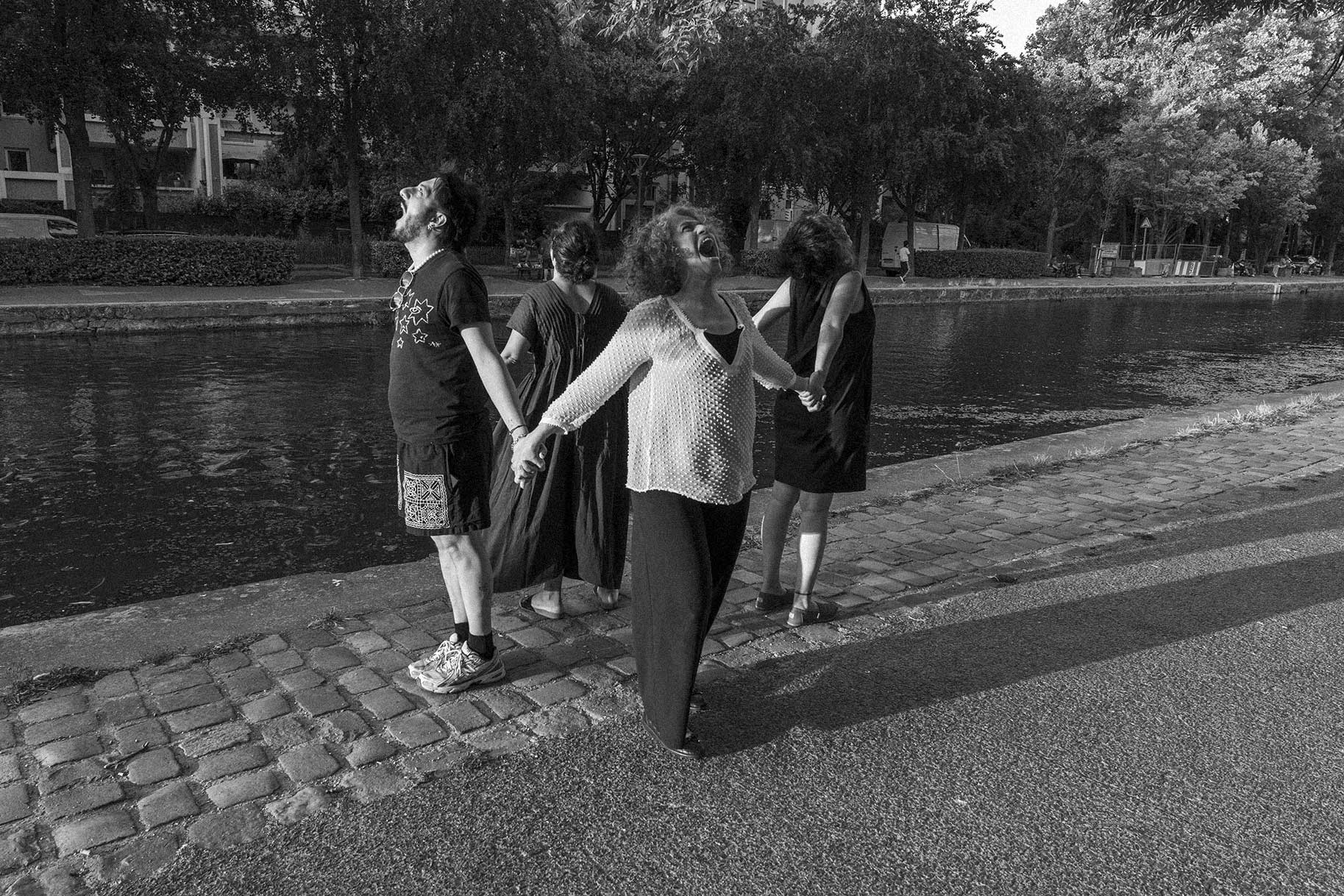
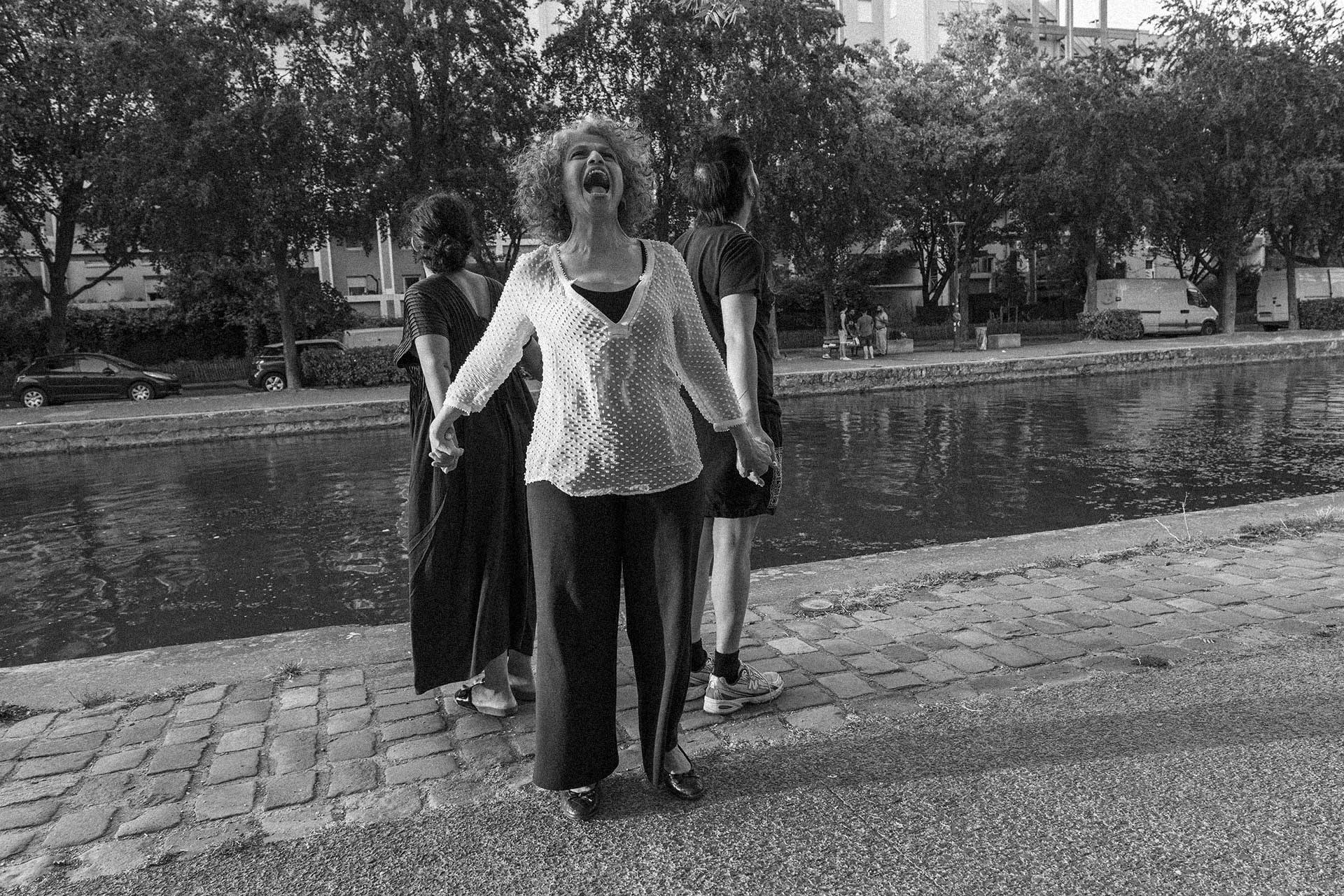
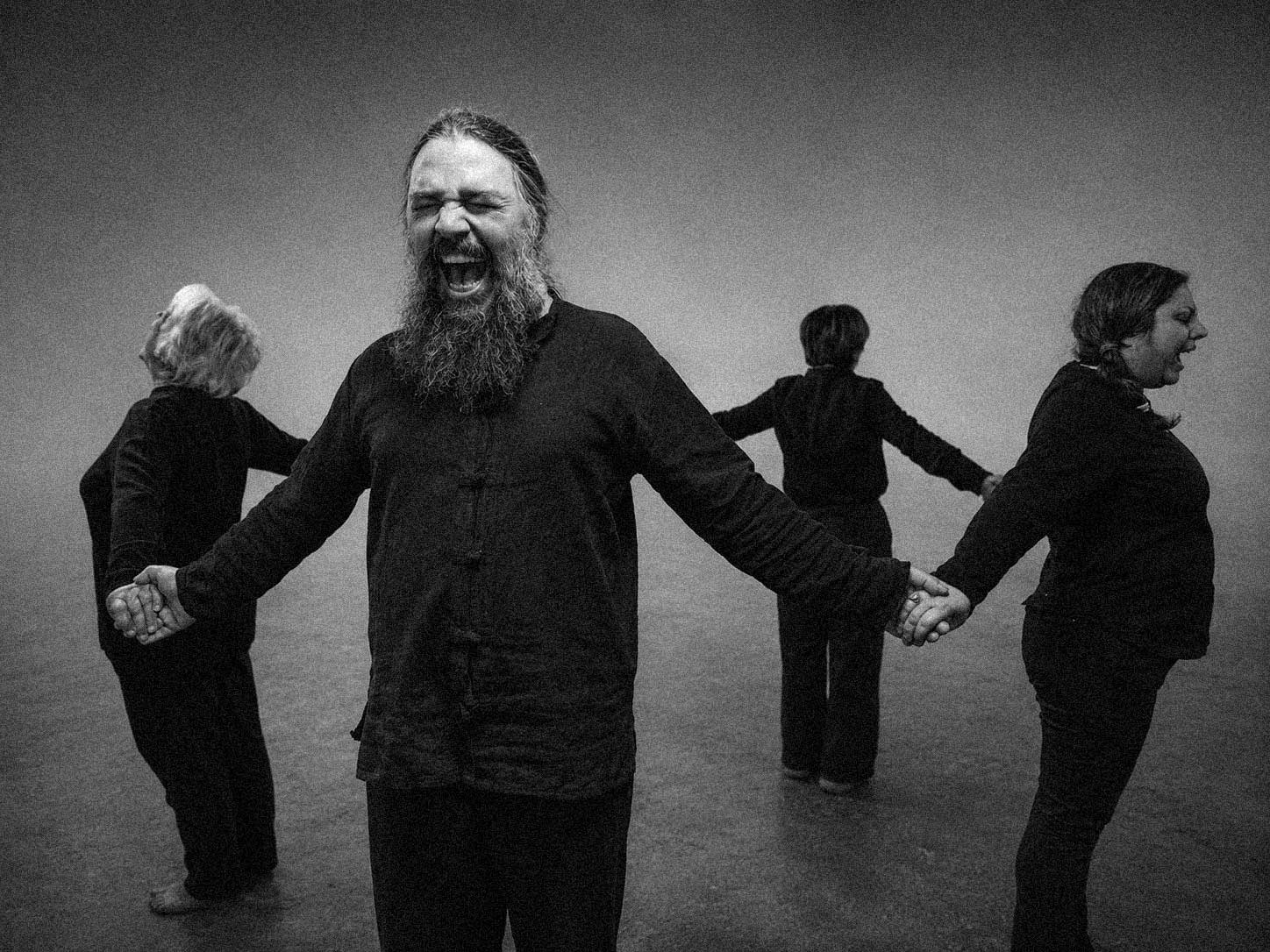
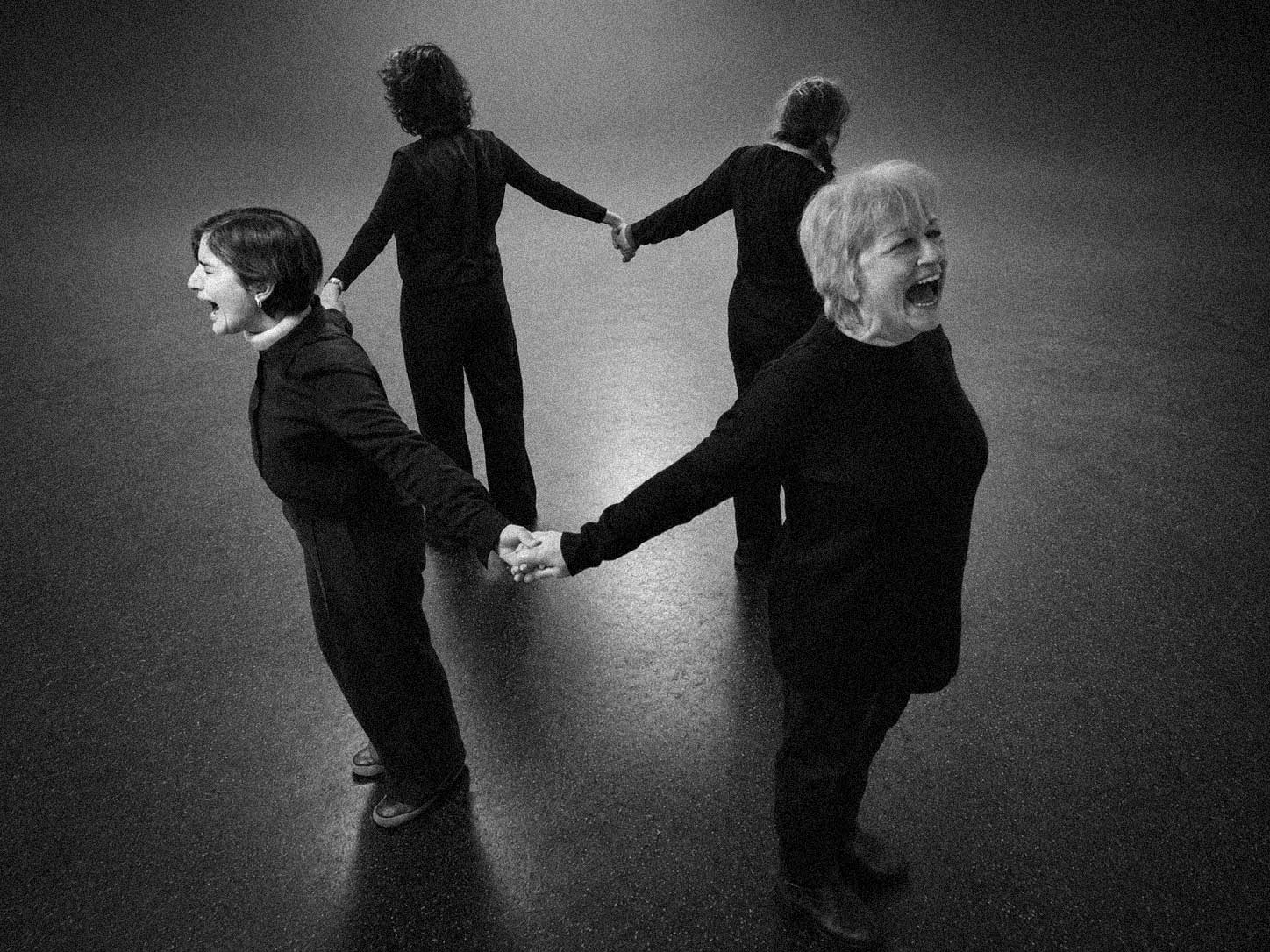
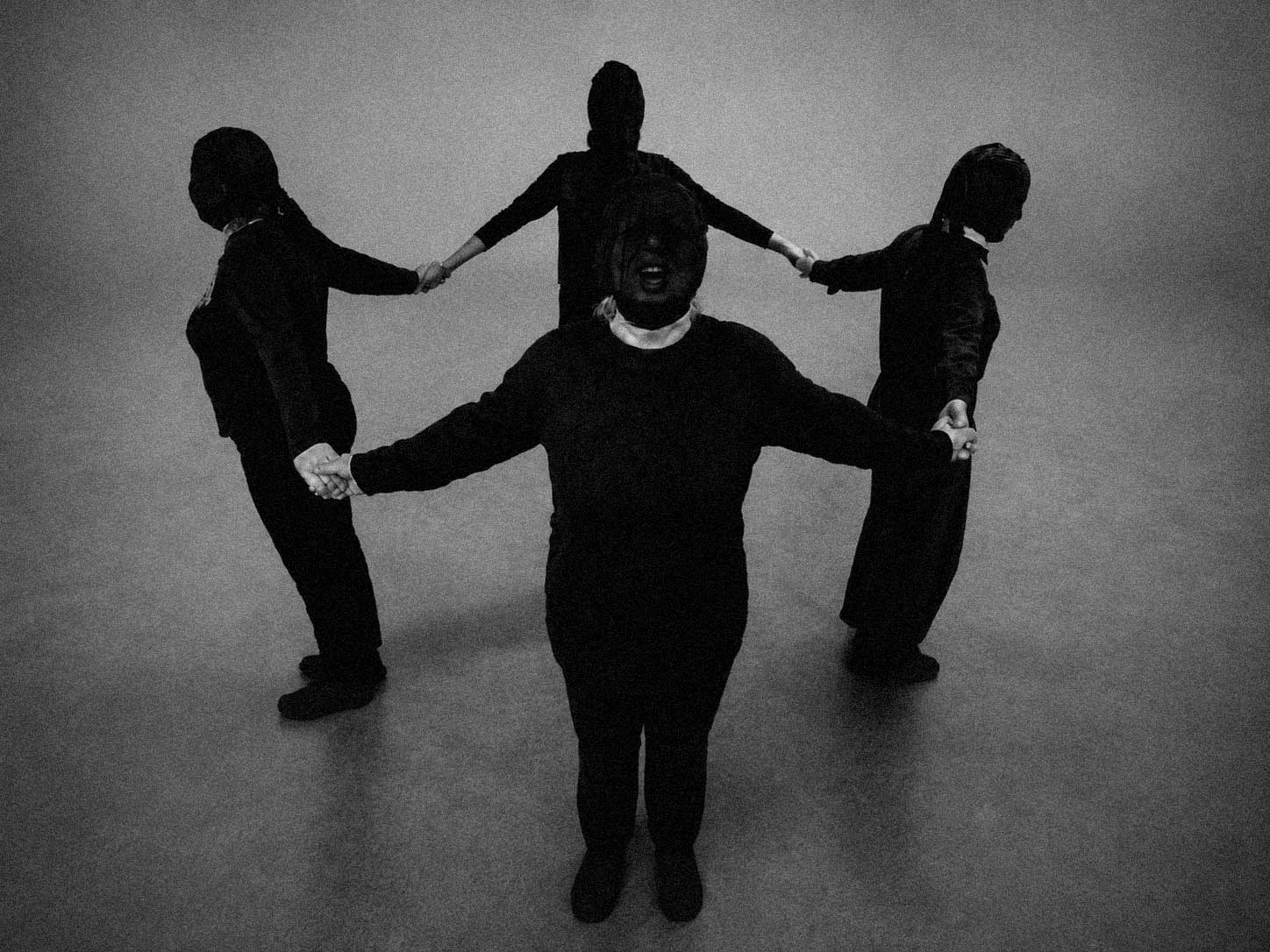
The Circle should not be understood first as a perfect spatial ring. Its primary force is structural: the holding-open of the void where speech fails. In spatial execution, this act may take several forms. A solitary Fibre can encircle the Wound through breath, aperture, count, posture, exposure, outcry, silent ⭘, and spatial punctuation. Two Fibres can form a dyad. Three may form an arc, line, or triangular relation. Larger Members can form a ring or mass perimeter. None of these forms is sacred, complete, or intrinsically superior. What matters is not geometric perfection, but the fragile formalisation of exposure: breath, touch or agreed proximity, count, outcry or silent ⭘, the that marks zero, separation between segments, and public address. The ring is therefore one operational intensification of encirclement, not the origin of the system.
Because this architecture is porous, the boundary of the Member is not permanently fixed. When the Wound is encircled in a public arena, incidental witnesses may remain outside the structure, encounter it from the surrounding field, or enter into relation with it. They become Fibres only if they actively join, assist, document, transmit, or otherwise participate in the Wound. The system therefore remains open without dissolving into an undifferentiated crowd. It expands through participation, not through passive exposure alone.
In Lingua Membra, the wounded subject may herself be the Fibre who initiates and executes the Wound, whether alone or within a Circle. Where a Circle forms, it does not stand outside her as though she were merely its object. It neither claims access to her interiority nor absorbs her singularity into a collective identity. Whether the wounded Fibre participates directly in the execution or the Wound is answered across distance, the Circle holds and answers the Wound as a formal public address through which what is most intimate to the wounded subject appears exterior, without claiming that the Wound reproduces, discloses, or masters the trauma left within her. The point here is not to reject care, but to prevent care from becoming fantasy, romanticised charity, appropriation, or mastery.

The Triple Register of Encirclement
Whenever this text speaks of encircling the , it does not refer merely to a theatrical arrangement, a perfect geometric ring, or a metaphor of communal gathering. Encirclement should be understood across three registers: psychoanalytic, somatic-typographic, and topological. These registers are not three separate actions, but three dimensions of the same execution.
The Psychoanalytic Register
In the psychoanalytic register adopted here, trauma names the bodily and psychic rupture left by an event, a rupture that cannot be adequately absorbed into speech, narrative, or symbolic coherence. Nothing prevents speech around that rupture, but no statement can exhaust it. The , in the specific sense established by Lingua Membra, is not that trauma itself. It is the formal execution through which is given public address. In this adapted sense, the Wound gives Pain public form through voice, breath, aperture, trace, and address, so that what is most intimate to the wounded subject appears exterior without the Wound claiming to reproduce, disclose, or possess the trauma left within her.
does not cure this rupture, interpret it, or close it through narrative mastery. It holds open the linguistic void marked by the Wound. The void is not filled; it is given a fragile formal edge. In this sense, encirclement gives a formal perimeter to the limit of articulation that the Wound makes publicly perceptible, without pretending that explanation can overcome it. This perimeter need not be geometrically perfect. It is a structure of address around what cannot be mastered.
The Somatic-Typographic Register
In the somatic-typographic register, the appears first not as a ring of bodies, but as an aperture in the body of the . The open mouth forms a visible circular opening at the moment of outcry or silent ⭘. This aperture is then formalised in the notation of the system through the typographic mark ⭘. The mark does not replace the mouth, nor does it convert the scream or silent outcry into a purely visual symbol. It is an auxiliary trace of the somatic act: the typographic mark of an opened mouth holding or releasing the into the shared field.
The Topological Register
In the topological register, encirclement may become spatial without having to become a ring. A solitary can hold the through the perimeter of her own body, mouth, breath, and count. Two Fibres can form a dyad; three may form an arc, a line, or a triangular relation; larger s can form a ring, chain, mass perimeter, or another site-responsive configuration. These formations create a public field without becoming a closed wall. They hold the Wound, project the scream or silent outcry outward, and establish the acoustic, visual, and somatic field in which witnesses encounter the execution. Their boundaries remain porous: those outside may remain witnesses, assist the Wound, document it, answer it elsewhere, or enter the structure as Fibres. The ring, when used, therefore claims space without becoming a sovereign enclosure.
These three registers become legible whenever the Wound is encircled. The linguistic void is held open, the mouth executes the somatic sign, and the executing Fibre or Fibres form a field of address through which the scream or silent outcry becomes public.
Solitary Execution
Lingua Membra is designed to persist even when reduced to a single . Under tyranny, occupation, surveillance, war, imprisonment, or any condition in which physical assembly is prohibited or dangerous, the solitary is not a lesser form of the work. It belongs fully to the work as a mode of execution. Political repression, however, is not the only reason solitude may become necessary. The architecture also accommodates Fibres whose bodily, neurological, sensory, affective, or spatial realities make collective gathering impossible, unsafe, or harmful. Severe social anxiety, agoraphobia, sensory overload, mobility constraints, vocal limitation, or other bodily conditions may require a Fibre to Wound outside the .
In such cases, the solitary Fibre does not become a failed or incomplete , nor does she merely carry the absence of a Circle. Her body is already capable of encirclement through breath, aperture, count, posture, exposure, scream or silent outcry, and spatial punctuation. Her execution functions as a call for resonance addressed to other Fibres and Members elsewhere, who may later answer the Wound in another place. The solitary execution therefore preserves the masterlessness of the system: no central body or authority is required to authorise the act, and no body is excluded because it cannot gather with others.
Because the later manual also defines several actions from the perspective of the full Circle, the solitary mode requires one clarification in advance. This principle also applies to the action later formalised as the Segment Separator, or . In collective execution, the separator is normally performed through the rotational movement of the Circle. In solitary execution, however, the Fibre can replace rotation with another spatial punctuation, including a brief forward-and-backward passage, provided that the division between chronological segments remains both audible and visible.
The Resonance Commons
The global network of is masterless in the specific sense that no archive, platform, administrator, or governing body may authorise a , validate the behind it, rank Members, or determine whose suffering counts. At planetary scale, however, a shared repository requires infrastructure and stewardship. This repository is called the Resonance Commons.
The Resonance Commons is conceived as a distributed or federated archive and connective layer rather than a command centre. Its function is archival and connective: to preserve such traces of Wounds as and Members choose to make public, register their chronological code and an appropriately precise or deliberately withheld location, and allow Members to encounter one another’s executions across distance. Stewardship of the Commons is therefore not mastery over the Wound. It is a limited, transparent, and contestable responsibility for consent, security, correction, removal, accessibility, duplication, malicious use, and the protection of those placed at risk by documentation.
When a local Fibre or executes a , that complete embodied execution of the Wound may, where safe and consensual, be documented and entered into the Resonance Commons alongside its date-code, a location no more precise than the participants judge safe, available traces, and a formalised hashtag. No image, voice, name, identifying feature, or precise coordinate should be published merely because it exists. Documentation does not found, authorise, or complete the Wound; the Wound remains grounded in the Fibre or Circle that executed it. The Commons only allows that local execution to become available to the wider masterless field without making exposure compulsory.
Through the Commons, a Fibre or Member can also issue a . Such a call is not a plea for psychological empathy, nor an order transmitted from a centre. It is an invitation to structural response. This response enacts care by answering the Wound as a public address, without claiming identification with the wounded subject. Distant Fibres or Members can answer by executing the same chronological code within their own geographic and historical conditions, allowing one Wound to be echoed without being possessed, translated into narrative, or subordinated to a single origin.
This lateral transmission converts a local somatic event into a possible chain of answering executions. Each answering Fibre or Circle remains autonomous; each execution belongs to its own site, body or bodies, language, risks, and political conditions. The Commons therefore does not unify the network through command. It allows dispersed Wounds to become mutually available and repeatable, so that when one Fibre is struck, other Fibres can choose to place their own bodies under the pressure of resonance.