HOW
The Manual of Somatic Execution
Lingua Membra becomes operative only when its argument is submitted to the body. Space, breath, touch, sound, sequence, and accessibility are the conditions through which that argument is tested. This manual sets out the positions, connections, timings, movements, vocal actions, and adaptive rules by which a , , or can execute and encircle a without a central conductor or . Its purpose is not theatrical choreography, but to make the Wound somatically repeatable across the widest possible range of bodies.
The Anatomy of Somatic Execution
The Outward Field
When the number of , bodily capacities, and physical realities of the site allow it, an outward-facing circle is preferable, though it need not be perfect in shape. For audibility and visual accessibility, especially for deaf or hard-of-hearing witnesses, the Fibres stand facing outward, so that the is projected into public space rather than enclosed within the group. This perimeter may form a human chain, anchoring the architecture in the long historical lineage of protest formations, vigils, barricades, mourning circles, and collective resistance. This outward orientation can support collective vigilance: some or all Fibres can voluntarily keep watch, alerting one another to approaching danger, police movement, anti-riot formations, plain-clothes agents, surveillance, intimidation, bullying, attempted disruption, crowd compression, kettling, arrests, sudden panic, or other shifts in the surrounding field. The formation must loosen or break immediately whenever bodily connection obstructs balance, movement, escape, or response to danger.
As more Fibres join an execution, acoustic mass, visual presence, and spatial reach may intensify, but the force of the Wound is not measured by scale alone. A solitary Fibre, a dyad, a trio, an arc, a line, an outward-facing circle of any workable size, and a mass formation may each carry the Wound. What changes is the density of address, the breadth of exposure, and the number of bodies taking part in the shared sequence of breath, counted scream, or counted silent outcry.
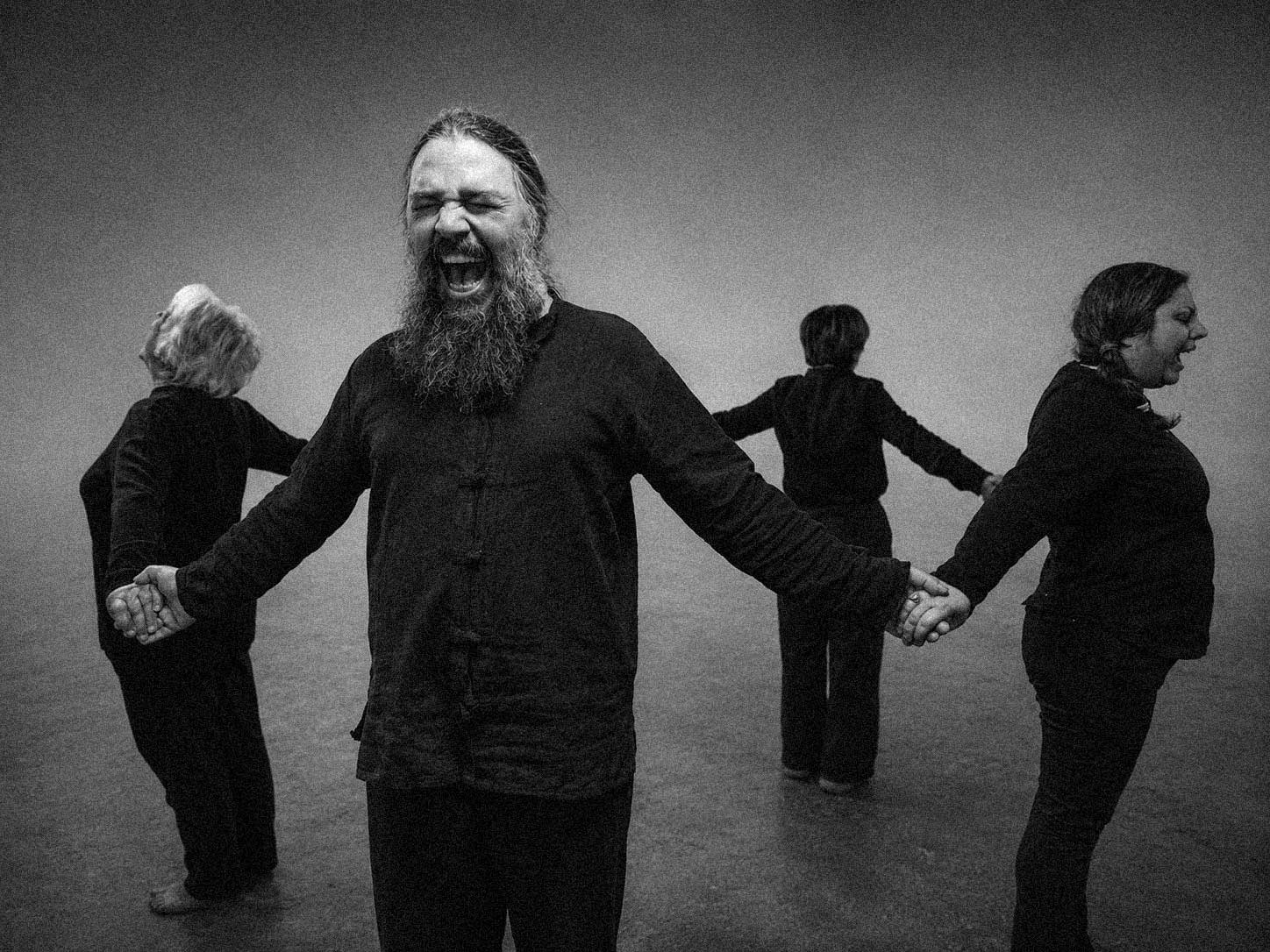
When the number of Fibres, bodily capacities, or physical realities of the site do not safely allow an outward-facing circle, the formation may take another shape capable of carrying the Wound. In such cases, what carries the Wound is not the exact formation of bodies, but the work of encirclement: shared exposure, shared timing, outward address, and mutual vigilance. Three Fibres can form a shallow arc, a frontal line, or a triangular relation, with , Hand Link, another agreed contact, or agreed proximity. Two Fibres can form a back-to-back dyad, each facing a different direction and keeping watch for the other. The dyad does not imitate a larger circle. It preserves encirclement in minimal relation: two exposed bodies, each projecting the Wound outward while keeping watch over the field outside the other’s sight.
Within Lingua Membra, these formations retain their force when they preserve the core elements of execution: synchronised breath where possible, counted scream or counted silent outcry, perceptible separation between chronological segments, bodily connection or agreed proximity, and exposure to the surrounding public field. The Circle is therefore not the source of the act’s force. What matters is the work of encirclement: holding the Wound through a body or several bodies oriented toward the surrounding public field.
The Modes of Connection
The mode of bodily connection within a or another formation is determined by scale, safety, bodily capacity, and the conditions of the site. The is generally suited to larger or denser collective formations, while the is generally suited to smaller formations or to situations where greater distance between is required. These modes are adaptive rather than compulsory. If hand-linking is impossible, painful, unsafe, or unwanted because of amputation, limb difference, injury, pain, sensory difficulty, or another bodily condition, the adjacent Fibres can establish contact through the shoulder, upper arm, back, wheelchair, mobility aid, or another agreed point of connection. If differences in height, reach, balance, or comfort make the Shoulder Lock difficult, the Hand Link or another adapted connection may be used. What gives these variations continuity is not a single grip, but a shared somatic relation: contact or agreed proximity through which breath, timing, movement, pressure where contact exists, and resonance can pass across the formation.
The Shoulder Lock
In the Shoulder Lock, each places their arms firmly but safely on the shoulders of the adjacent Fibres. This creates a shared somatic bridge through which breath, pressure, tremor, and preparatory movement can be felt across the formation. Its purpose is not to erase the singular voice of each Fibre, but to connect distinct bodies in a shared field of timing and exposure. When the screams begin, the sound remains biologically plural, yet the shared connection allows those plural voices to strike as a gathered acoustic mass.
The Hand Link
In smaller formations, or whenever the is not feasible, can establish connection by linking hands, wrists, forearms, or another agreed point of contact. The arms may extend outward, but they need not be rigidly straight. What matters is a felt connection through which bodily timing can pass. This connection facilitates the : during the preparatory breaths, linked hands, wrists, forearms, or other agreed points of contact rise with inhalation and descend with exhalation, allowing the formation to coordinate without a central conductor. One shared preparation consists of five silent cycles of this pulse before the begins. The Somatic Script is the repeatable coded pattern through which the date is bodily executed. Bodily safety or site conditions may require adaptation.
Breath Synchronisation
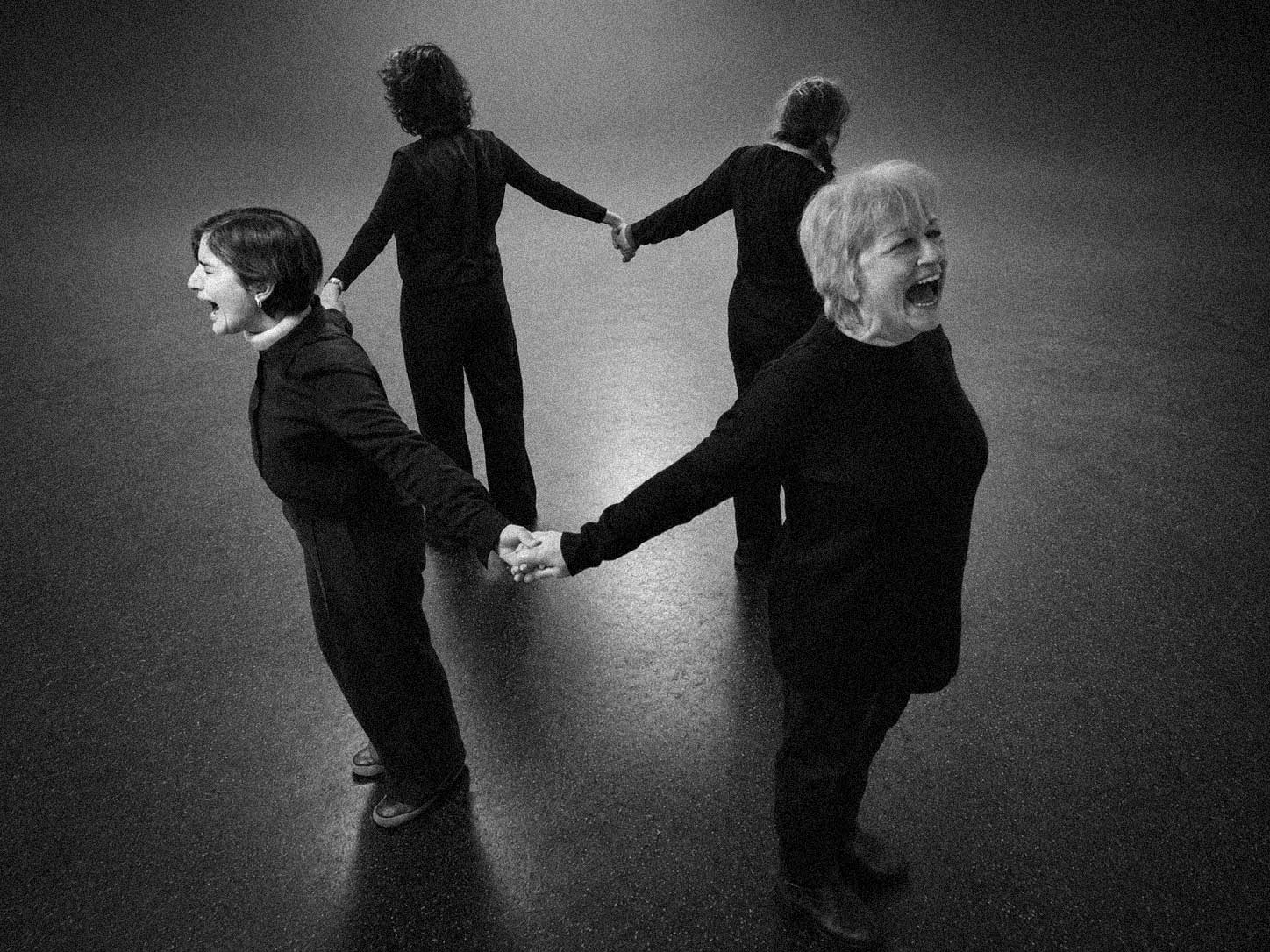
Because the formation is organised through bodily connection or agreed proximity, the rise and fall of the chest, shoulders, arms, hands, mobility aids, or other agreed points of connection during the preparatory inhale and exhale can be felt, seen, or otherwise registered across the formation. This allows shared timing without a central conductor. The conspire in two senses: first, as a temporary secret compact, since the chronological message has not yet been deciphered by witnesses and remains immediately legible only to the participating Fibres; and second, etymologically, as a temporary body that breathes together, from con- and spirare, “to breathe together”. The same structure is present in the Persian word ham-nafas: literally, one who is “with-breath” or “same-breath” with another; by extension, an intimate companion, confidant, or one whose presence and rhythm are deeply shared. Saʿdi gives the term its full existential force in the verse Meqdār-e yār-e ham-nafas chon man nadānad hich kas / Māhi keh bar khoshk oftad qeymat bedānad āb rā: “None knows, as I do, the worth of a ham-nafas companion; the fish cast upon dry land knows the value of water.” In any formation, the Fibres become ham-nafas in this literal sense: their timing is carried not by command, but by shared respiration, bodily pressure where contact exists, and the felt or visible rise and fall of connected or proximate limbs and bodies. This somatic transfer of respiratory timing is also a mechanism of structural inclusion. Fibres who do not hear the count or the outcry may still receive the rhythmic cue through somatic vibration, pressure where contact exists, and the visible movement of adjacent bodies and limbs.
Enactments and repetitions by participating Fibres have so far suggested that synchronisation can strengthen as bodies work together, but this remains an observed tendency within the developing practice, not a settled empirical law. Once Lingua Membra becomes public, future Fibres and will inevitably test, modify, and complicate this claim, often without the author’s knowledge or supervision. The system therefore leaves this point open. This bodily connection or agreed proximity should not be treated as proof of a fused collective nervous system, but as a practical condition for timing, inclusion, breath coordination, and possible bodily attunement among the participating Fibres.
Topological Adjustments
Each formation is adaptive. It may expand, contract, loosen, or reshape itself to include wheelchairs, walkers, crutches, prostheses, mobility aids, support persons, or other necessary supports without breaking the shared formation. Inclusion does not require geometric purity. What matters is the continuity of relation and the preservation of bodily safety.
During rotational enactments, any rotating formation moves at the pace of the whose body requires the slowest pace. Fibres who experience disorientation, left-right confusion, dyspraxia, vestibular difficulty, sensory overload, panic, visual impairment, or difficulty processing directional instructions may take their cues from adjacent bodies rather than from verbal instruction. Neighbouring Fibres can guide orientation through pressure where contact exists, breath, visible or felt movement, and other agreed cues, allowing the rotational sequence to continue without requiring every body to process direction in the same way. When left-right instruction is difficult for any Fibre, orientation may be established through pressure where contact exists, a prior tactile cue, visible movement, or a locally agreed signal.
Vocal Adaptations
The absence of emitted voice does not exclude a from the execution. A Fibre who does not emit a scream because of aphonia, vocal paralysis, respiratory limitation, speech disability, exhaustion, panic, injury, danger, preference, or any other bodily condition can execute the ⭘ silently. In such cases, the mouth opens on the count, or, in collective execution, in time with the shared screams; breath may be released without voice when it is bodily possible and safe, and when the conditions of the site allow it.
This silent execution is not a lesser form of participation. It preserves the aperture of the opened mouth, the respiratory effort of the body, and the visible address of the . Lacan’s reading of Munch’s The can be invoked here with care: the cry does not need to be emitted in order to be a cry; in Munch’s image, the open mouth represents a cry, yet nothing emerges from it but absolute silence. Where sound is not emitted, the aperture itself becomes the trace of the outcry: a silent mouth holding open the place where the voice would have left the body.
Anonymity and Membrane
After the manual has defined bodily field, connection, breath, adjustment, and vocal adaptation, the question becomes how a enters the execution without becoming a portrait. For solitary and collective executions alike, Fibres retain authority over their vestment. The plain black configuration used in the author’s previous works and in rehearsals for this architecture is proposed as a template, not as a mandate. In this template, the body is covered in black from head to foot, and the face is concealed by a simple, inexpensive, opaque black head covering. A single circular aperture is left for the mouth.
The purpose of this membrane is not theatrical characterisation, ritual purity, or mere aesthetic uniformity. It turns the body into a human shadow. This shadow-form matters because the human shadow is among the most common and immediately recognisable images of the human body: anonymous, fragile, upright, and exposed. The Fibre becomes neither character nor portrait, but the dark outline of any body that may have endured the . Within this silhouette, the mouth remains exposed as the site of the outcry. The aperture transfers the into the body itself: the opening around the mouth visually repeats the mark ⭘ and frames the voice as the point at which the Wound leaves the body and enters the shared field.
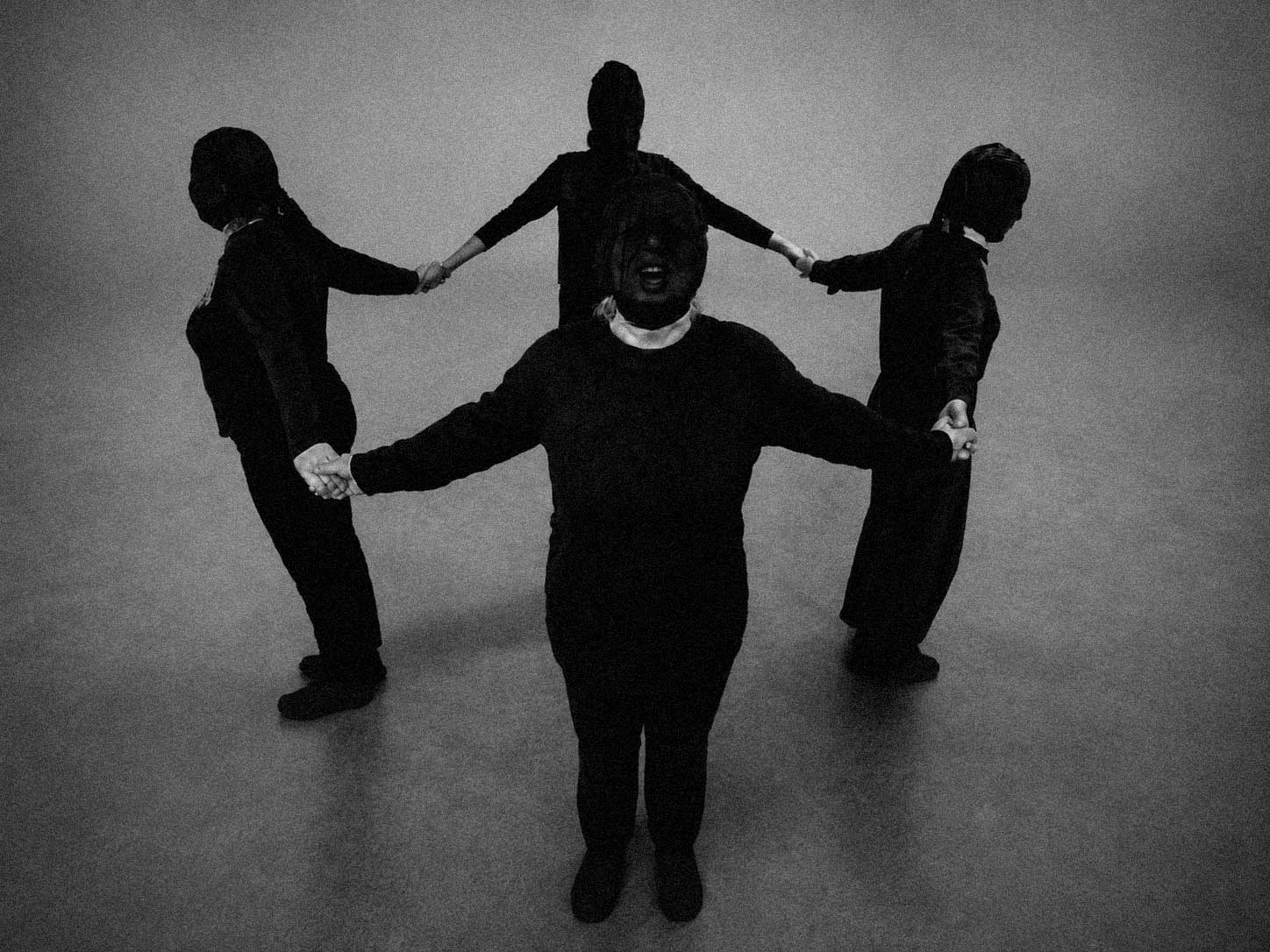
This template must not become a compulsory icon. A can alter or abandon it when climate, law, danger, disability, sensory sensitivity, cultural context, or available materials require another form. What must be preserved is not a costume, but the structural function: the body enters the execution without becoming a portrait, and the mouth, aperture, breath, assisted vocalisation, or silent execution remains the means through which the Wound is addressed. The membrane therefore prepares the passage from bodily procedure to notation: the mouth-aperture becomes the visible threshold through which the numerical code can be executed.
The Somatic Vocal Code: Notation and Thresholds
Timing is anchored in the Somatic Vocal Code, where the aligns breath, count, and outcry with the wider body politic. Even in isolation, the Fibre uses this code to make a solitary pulse available to other Fibres and . The Somatic Vocal Code is a non-lexical system used to encode chronological data through the body of the Fibre and, in collective execution, through the bodies of participating Fibres in a or another formation. It translates digits into specific vocal actions, allowing the Fibre or Member to script the date of a calamity into the air.
Counting as the First Threshold
The numerical layer keeps entry into Lingua Membra deliberately low. This threshold does not require mastery of a natural language, a speculative, doctrinal, or metaphysical tradition, or a specialised aesthetic code. It begins with a competence closer to counting than to interpretation: the ability to distinguish discrete counts, their recurrence, and the intervals of silence between them, whether a count is sounded or executed silently. In the formal code, this threshold is carried by the digits 1–9 and by Ø, the that marks zero acoustically. These signs are not offered as advanced mathematics, nor as private symbols requiring initiation. They are simple public devices through which the numerical outcry, silent ⭘ execution, and the Muffled Hum can become countable.
This is why the system can be approached at the widest possible human scale without pretending to be literally universal. Counting is among the most elementary operations by which human beings stabilise experience: through fingers, marks, stones, strokes, bodies, written digits, or other external traces. It crosses divisions of literacy, language, class, nation, and racialisation more easily than doctrine, style, or symbolic exegesis. A natural language takes years to learn; a speculative, doctrinal, or metaphysical vocabulary may require formation; an aesthetic code may remain closed to those outside its training. But the distinction between a discrete count and the interval that separates it from another stands much nearer to the lowest shared threshold of human cognition.
This claim should remain modest. The cognitive evidence does not make the date-code innate; it only supports the narrower claim that an exact public count can be built from a low-threshold numerical operation. Research on numerical cognition distinguishes early systems for approximate quantity and for small exact sets; these systems support basic numerical intuition without by themselves producing advanced mathematics or exact large-number calculation. The important limit is that exact counting, when it must endure beyond immediate perception, usually needs public supports: number words, digits, tally marks, inscriptions, or other signs that allow a quantity to be remembered, repeated, transmitted, and checked once the outcries and Muffled Hums are no longer available to hearing or sight. Lingua Membra adopts counting in this minimal technological sense. It does not turn outcry, silence, or the Muffled Hum into mathematics. It gives the numerical units a simple public form by which they can be marked, held, repeated, and deciphered. Silence remains the absence of sound and does not become zero merely by being silent; an adapted silent ⭘ remains countable because of its visible and bodily execution.
The date-code is the default form of chronological inscription in Lingua Membra, but it is not treated as the only possible relation to time. Some or may belong to societies, communities, or ritual formations in which calamity is remembered through seasonal, lunar, oral, genealogical, liturgical, agricultural, or other temporal systems. In such cases, the numerical code remains available, but it does not exhaust the ’s relation to time. The provides the field in which these other temporalities may be carried.
The Numerical Outcry (Digits 1 to 9)
Each digit from 1 to 9 is represented by a corresponding number of screams. This preserves the bioacoustic argument established earlier: the code privileges the scream because acoustic roughness gives it its alarming force. The numerical unit is therefore not a spoken syllable, chant, melody, or theatrical utterance, but one rough alarm outcry.
The scream may be forceful according to the capacity and choice of the Fibre and is rough in texture. The aim is not vocal beauty, maximum volume, or theatrical expression, but the execution of one distinct numerical unit of the . Each numerical unit begins with an inhalation and is released as one scream on the following exhalation. Its duration is not prescribed. Consecutive screams must remain perceptibly distinct and countable. This respiratory unit is repeated once for each count within the digit.
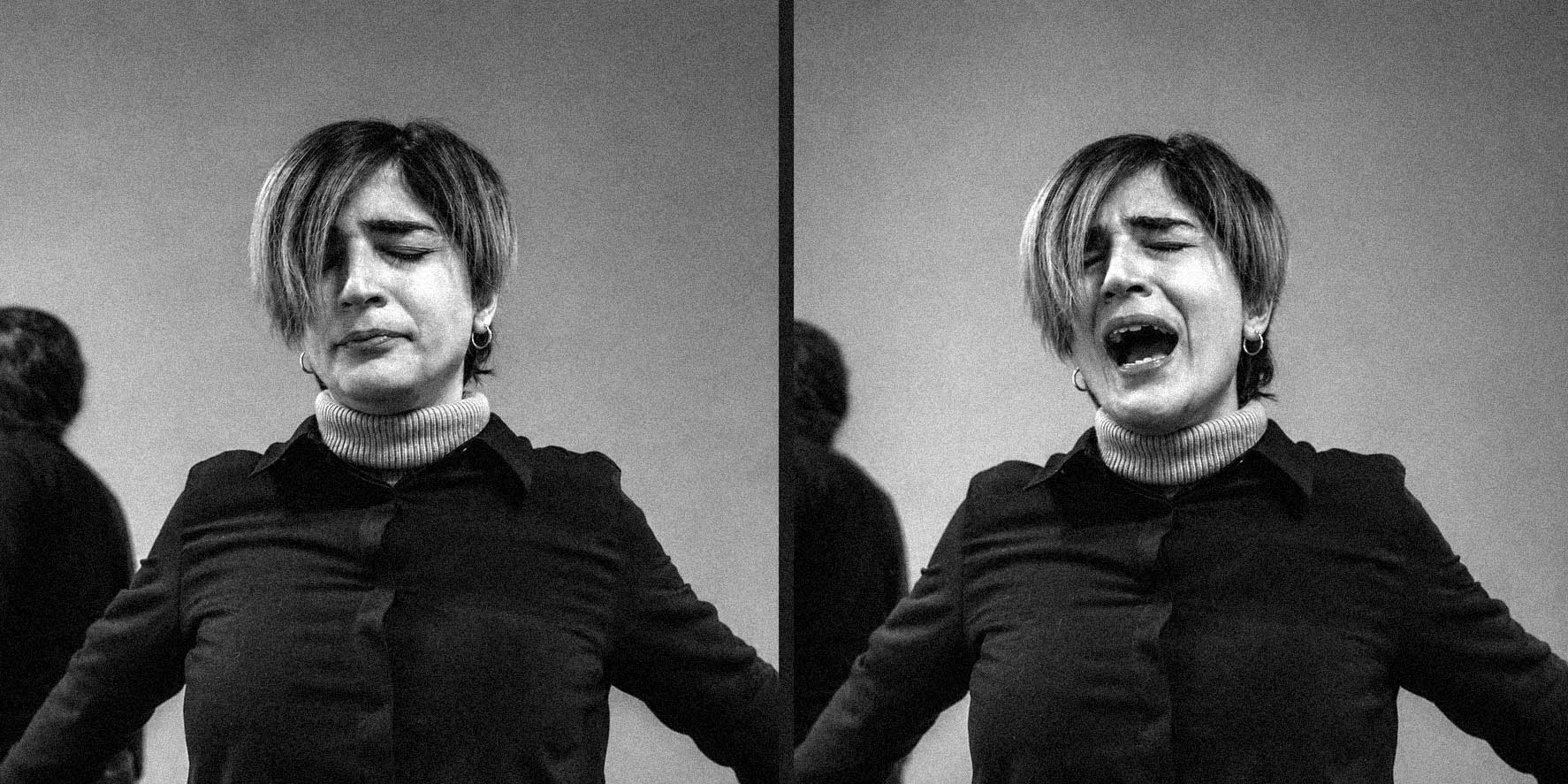
The system does not require moderation of affect, but it must not equate extremity with injury. A or can choose a radical, overdriven, or forceful cry, yet no one should be encouraged to approach loss of breath, vocal damage, faintness, panic, or another unsafe bodily threshold. Lingua Membra does not ask the Wound to become timid, polite, or acoustically bearable, but intensity is not what constitutes the execution. An execution is not structurally superior because it is louder, longer, harsher, or more physically exposed. Nor should adapted execution be mistaken for a weaker form: a silent ⭘ may at times be more arresting for witnesses than an emitted cry, precisely because the outcry is held in the open mouth, breath, count, and bodily address without being released as voice. The code continues to operate when the outcry is forcefully projected within a safe range, cautiously released, broken, whispered, breath-based, or displaced into a silent ⭘ execution because of bodily limitation, danger, exhaustion, vocal incapacity, or choice. In these adapted forms, the outcry is not abolished; it may be carried through breath, aperture, count, and bodily address. What matters is the repeatable relation between number, breath, outcry, and Wound.
The Muffled Hum (Digit 0)
The digit zero is sounded as a Muffled Hum and notated as Ø. Unlike the numerical outcry, which is produced through the open mouth, the Muffled Hum is produced with the mouth closed. The sound should be muffled and inwardly resonant, vibrating through the mouth, nasal cavity, throat, or chest according to the capacity of the . When the Fibres are linked or otherwise connected, this vibration can also pass through points of contact, mobility aids, or other agreed connections into adjacent bodies, while still extending outward into the acoustic field of the .
The Muffled Hum is an emitted sound, not silence. It is the sounded mark of zero within the chronological code. Each Ø should be treated as a single numerical unit, held briefly and followed by a respiratory reset, so that repeated zeros remain countable. Its function is to preserve the structure of the date without breaking the somatic tension of the execution.
The Notation
⭘ = : A single numerical outcry. The mouth opens and the scream is released; in adapted execution, the mouth opens silently while preserving the count, aperture, and bodily address of the .
Ø = Slashed Circle: A single zero-unit. In sounded execution, the lips remain closed without strain as the produces a brief that may vibrate through the mouth, nasal cavity, throat, chest, and, where the Fibres are linked or otherwise connected, through adjacent bodies. In silent or non-phonating execution, the lips remain closed for the same count while the unit is marked through an agreed visible or tactile pulse, such as a small lift and release of linked hands, a brief pressure pulse, or another locally accessible cue.
– = Dash: . Three comfortable cycles of inhalation and exhalation, adapted to each Fibre’s safe respiratory range, followed where possible by an audible exhale on the fourth breath.
/ = Forward Slash: Segment Separator, or . A perceptible transition between chronological segments, often rotational in collective execution and executed, where possible, through deliberate dragging steps. A displacement of approximately sixty degrees is practical in many Circles, but the angle can adapt to the scale of the , bodily safety, and the spatial conditions of the site. The direction should be given in body-relative terms, as movement towards each Fibre’s left or towards each Fibre’s right, rather than through clock-face orientation.
The Code Operations
Digit Count: Synchronised Outcries (⭘)
This action produces a shared wall of sound: a rhythmic assertion of presence encountered by the surrounding witnesses, passers-by, and the themselves. Within this shared resonance, the Code is designed to remain available across more than one sensory register, but not every body receives the same register. Blind or low-vision witnesses outside the may perceive the sequence through its acoustic structure: the open-mouth screams, the marked by Ø, the cadence of respiratory resets, and the dragging of feet during the . Deaf or hard-of-hearing witnesses outside the Circle, as well as witnesses whose hearing is obstructed by distance, crowd noise, police sirens, panic, or site conditions, may perceive the same sequence through its visual structure: the rhythm of opening mouths, the agreed visible marker of the closed-mouth zero-unit, the rise and fall of linked or otherwise connected limbs and bodies, the rotational displacement of the Kinetic Pivot, and the visible punctuation of the sequence.
Inside the Circle, however, visual access to other Fibres is not required: the Fibres stand facing outward, and repetitions have shown that many close their eyes during the screams. For Fibres within the Circle, including deaf or hard-of-hearing Fibres, the count may be received through pressure, contact, shared breath, dragging steps, and vibration passing through the linked or otherwise connected perimeter. In Lingua Membra, these acoustic, visual, and somatic elements never function as autonomous representational signs. They operate only as auxiliary traces of the somatic code, supporting accessibility without replacing the acoustic and bodily event.
Digit Separator: Simultaneous Breathing (–)
This action marks the transition from the jagged strike of the scream to a sudden collapse of the acoustic wall. It is an architectural cut in the air: the jagged force of the scream is suspended and replaced by the collective labour of the lungs. The Digit Separator consists of three comfortable cycles of inhalation and exhalation, paced together where possible without forcing depth, rate, or duration, with the mouth closed where this is safe and comfortable. On the fourth breath, the , , or other formation releases an audible exhale where possible, after which the next numerical unit begins. Any Fibre can shorten, soften, or omit this respiratory action if it produces dizziness, light-headedness, breathlessness, pain, panic, or another unsafe bodily response.
In collective execution, the physical configuration of a Circle or another formation shapes how this breath is perceived. In a , the cycles are performed as a : linked hands, wrists, forearms, or other agreed points of contact rise with inhalation and descend with exhalation. In a , the connection is intensified by proximity, allowing Fibres to feel the expansion and contraction of neighbouring bodies. This creates a rhythmic and tidal movement through the Circle. The Separator therefore does not simply divide numbers. It gathers the Fibres again through breath before the next scream is released.
Segment Separator: The Kinetic Pivot (/)
The transition between chronological segments is marked by the Kinetic Pivot. This rotational passage separates Day from Month, Month from Year, and, where required, the opening date-code, or , from the closing date-code, or . The turns through deliberate dragging steps, moving either towards each ’s left or towards each Fibre’s right according to the ’s prior agreement. A displacement of approximately sixty degrees has proved practical in rehearsals, but the angle is not rigid. It may be adapted according to the scale of the Circle, the density of the surrounding field, bodily safety, mobility aids, police pressure, architectural obstacles, or the conditions of the ground.
This is the collective form of the separator. Its structural function, however, is broader than rotation: it cuts one chronological segment from the next through a perceptible shift in space, sound, and orientation.
In solitary execution, where no linked Circle exists to rotate, the Kinetic Pivot may be adapted into a brief forward-and-backward passage or another deliberate displacement suited to the site. What distinguishes the separator is not rotation as an absolute form, but division as a perceptible event. The separator interrupts the sequence between chronological segments and makes that interruption both audible and visible: through dragging steps, the scrape of a foot, the contact of a mobility aid, a wheelchair’s movement, or another deliberate action that can be perceived both audibly and visibly.
The pivot prevents the from remaining fixed in a single frontal address. By turning, the Circle exposes different sides of the linked body to surrounding witnesses and allows the scream to strike the public field from shifting orientations. Upon completion of the Year, a final pivot may conclude the first whole date. If an Outro is performed, the sequence may be repeated so that the Wound passes again through the surrounding space.
Throughout these pivots, Fibres take continuous, deliberate steps while dragging their feet against the ground, when possible and safe, to produce an audible scraping sound. Fibres using wheelchairs, walkers, crutches, prostheses, or other mobility extensions can adapt this friction through wheels, feet, aids, or another agreed sound-making contact with the ground. This acoustic dragging helps blind or low-vision witnesses track the displacement and changing orientation of the Circle through sound. It also allows Fibres inside the Circle to feel the transition through pressure, contact, and movement, rather than relying on sight or verbal instruction.
The Fibres remain stationary during each scream. At these static points, each Fibre modulates their vocal output according to their own physiological and somatic state. Variations in glottal pressure, breath capacity, vocal strain, exhaustion, fear, pain, or restraint may produce a spectrum of vocal textures, from breathy vocalisations to pressured screams marked by high-intensity noise or nonlinear vocal phenomena. This diversity of tone is not a failure of synchronisation. It ensures that the scream remains an organic event rather than a uniform mechanical signal.
The Kinetic Pivot therefore creates a sensory field punctuated by open-mouth screams, , respiratory resets, and acoustic dragging. Blind or low-vision witnesses may follow the transition through sound: audible screams, where sounded, the Muffled Hums as resonant numerical units, and the dragging feet or mobility aids as markers of displacement. Deaf or hard-of-hearing Fibres within the Circle may receive the same transition through pressure, contact, shared breath, visible or felt movement, and vibration passing through the linked or otherwise connected perimeter. Although the initiation of the scream requires structural synchronisation, its duration remains governed by each Fibre’s breath capacity, restraint, and bodily limit. This staggered cessation of breath is not a defect in the collective, but a welcome biological variance, preserving the scream as a diverse organic mass rather than a synthetic unison.
Somatic Vocalisation Typology Table
This table categorises human somatic vocalisations, together with the silent limit-case of the opened mouth, that may express affective states and register bodily trauma without defaulting to semantic speech. It is informed by empirical acoustic and cross-cultural research, but it should not be read as a fixed scientific taxonomy. As established above, the core ⭘ execution is grounded in the alarm scream because its rough acoustic texture has the most direct support within the neuroacoustic architecture of the system. The subsequent vocalisation types may contain roughness, rhythm, pitch instability, breath fracture, culturally patterned forms of lament, or, in the case of the silent scream, the visible aperture of the scream without emitted sound. They do not provide the same default biological threshold for the global code. They therefore belong primarily to the , except where a vocal limitation or deliberate silent execution makes the silent scream an adapted form of ⭘.
Somatic Vocalisation Typology Table in PDF format.
Type | Description | Acoustic Traits | Status in the Code | Notes |
|---|---|---|---|---|
/ Alarm outcry | Rough alarm vocalisation | High intensity, rough texture, sharp onset, rapid temporal modulation | Core ⭘ execution | Strongly cross-culturally recognisable, though not universally identical in reception. Its rough acoustic texture provides the basis for the core numerical outcry. |
Silent scream | Open mouth without emitted cry | No emitted sound; visible aperture; possible breath pressure without phonation | Adapted ⭘ execution / Free Score execution | Available when sound cannot be produced or when silence is deliberately chosen. The opened mouth preserves the geometry of the outcry: the cry is represented through absolute silence, and the becomes visible without leaving the body as voice. |
Shriek | Extremely high-pitched piercing vocalisation | Very high pitch, sharp onset, often narrow and piercing | Free Score execution | May accompany shock, fear, or sudden distress, but it does not form the default numerical unit unless executed as a distinct, countable scream within the core ⭘ sequence. |
Howl | Sustained, loud, open vocal cry | Prolonged duration, high volume, extended breath, possible pitch instability | Free Score execution | Useful for extended grief, desolation, rage, or collective mourning. It belongs to the Free Score when executed as a howl rather than as the numerical scream. Duration alone does not determine whether a vocalisation can serve as a countable ⭘ unit. |
Wail | Prolonged cry with rising and falling pitch | Fluctuating pitch, extended duration, pulsed or wavering contour | Free Score execution | Often associated with mourning and lament, but culturally variable. It can carry local grief without becoming semantic speech. |
Keening | Highly patterned mourning vocalisation | Sustained pitch, rhythmic pulsing, repetition, ornamented contour | Free Score execution | A culturally marked form of collective lament. It should remain nonlexical by default. |
Sob | Broken cry interrupted by breath | Irregular pacing, fractured breath, pulsed onset, intermittent voicing | Free Score execution | Useful for breath-fracture, exhaustion, grief, or collapse. Its irregularity may enter the Free Score without needing to become numerically countable. |
Moan | Soft or sustained voiced sound | Low to mid pitch, continuous or slowly modulated, often smooth | Free Score execution | Ambiguous and bodily rather than fixed in meaning. It may register pain, depletion, desire, grief, effort, or other states depending on context. |
Groan | Low, sustained, muffled vocalisation | Low pitch, rough or smooth texture, continuous pressure | Free Score execution | Often produced under strain, discomfort, fatigue, or heavy bodily effort. It can thicken the lower register of the Free Score. |
Grunt | Short guttural vocal closure | Low pitch, abrupt onset, brief duration, throat-centred pressure | Free Score execution | May register effort, impact, disgust, resistance, or bodily weight. Its brevity makes it usable as rhythmic material in the Free Score. |
Gasp | Sudden intake of breath | Inhaled onset, sharp intake, brief duration, high salience | Free Score execution | A pre-lexical respiratory event rather than a voiced outcry. It may mark shock, interruption, fear, or sudden exposure within the Free Score. |
Sigh | Prolonged audible exhalation | Low intensity, extended exhale, often descending contour | Free Score execution | May register depletion, resignation, relief, grief, or exhaustion. It belongs to the respiratory architecture rather than the core alarm code. |
Non-lexical shout | Loud abrupt vocal burst without semantic words | High volume, sharp onset, open vowel or rough burst | Free Score execution | If it becomes a lexical slogan or speech, it leaves the default non-lexical architecture. Kept non-lexical, it may function as force, warning, anger, or collective pressure. |
Whimper | Soft intermittent cry | Low intensity, short duration, tremor, breath-fracture, repeated onset | Free Score execution | Useful for acute vulnerability, fear, pain, or exposed fragility. Its low intensity can offer a counterpoint to the mass force of the core outcry. |
Non-lexical chant-like cry | Rhythmic repeated vocalisation without semantic lyrics | Regular rhythm, repeated vowel or syllabic sound, pulsed contour | Free Score execution | Allows ritual, protest, or collective cadence without defaulting to words, slogans, or lyrics. Cultural variation remains significant. |
The Free Score
Between the coded and , the executing body can choose to enter the Free Score, though this transition remains optional and is not a structural requirement of the system. In solitary execution, the executing body is the ; in collective execution, the choice belongs to the or rather than to a single Fibre acting apart from the agreed execution. Should this interval be opened, the synchronised structure of the biological alarm gives way to a fluid composition of affective vocalisations. While the core screams of pain, fear, and alarm provide the shared acoustic threshold of the system through roughness, the Free Score offers a zone of autonomy for Fibres and Members. It operates as a vessel for diverse affective states, including sadness, mourning, anger, tenderness, exhaustion, or profound grief, that fall outside the jagged acoustic territory of the core alarm.
Instead of remaining bound to rough acoustic friction, these sounds may manifest through harmonic resonance, melody, pitch, rhythmic repetition, broken breath, or unstructured vocal disorder, according to the somatic and cultural disposition of the executing body. This interval functions as a site where cultural memory enters the execution and impresses its specific signature or historical tint upon that body or collective tissue.
Such an instantiation may occur, for example, when a Fibre or Member grounds its vocal track in a shared cultural repertoire while keeping the execution non-lexical: filtering a regional revolutionary song through non-lexical melodic vocalisations, transforming the memory of a traditional lullaby into a structural wail, drawing upon localised mourning laments, funerary ululations, work songs, devotional cries, non-lexical protest rhythms, or collective keening practices, or rejecting melodic frameworks altogether in favour of unstructured cacophony. To articulate the weight of a catastrophe without defaulting to speech, the vocal output may therefore become structured melody, anti-melodic disorder, or a fluctuation between these states, leaving the execution to the cultural and bodily dispositions of the executing Fibre or Member.
Fibres can also draw from the non-lexical somatic vocalisations catalogued in the Somatic Vocalisation Typology Table, while remaining free to integrate supplementary modalities into the framework and initiate a non-lexical horizontal exchange with other Members across the global masterless network. By combining and extending vocal profiles such as the fluctuating pitch of the Wail, the irregular pacing of the Sob, or the rhythmic repetition of the non-lexical chant-like cry, the executing Fibre or Member can sonically script the affective course of a personal rupture, historical struggle, or catastrophe through raw breath and resonance.
Plural Calendars and Non-Calendar Temporal Systems
The explicitly accommodates and whose relation to time cannot be reduced to a standardised calendar, whether because another calendrical system governs the community’s temporal understanding, because a calendar is not the primary archive of the community, or because a Fibre or chooses to reject calendrical authority altogether. Some calamities are remembered not by numbered day, month, and year, but by ecological cycles, seasons, harvests, floods, droughts, reigns, exiles, imprisonments, massacres, migrations, generational lineages, landmarks within the landscape, or inherited oral memory. Lingua Membra must not force these histories into a foreign calendar merely to make them countable.
Where temporal knowledge is held by elders, daykeepers, ritual practitioners, calendar specialists, or other custodians within the originating community, the form of execution must not be devised from outside through conjecture. Those who carry that knowledge should be consulted and, wherever possible, directly involved in determining whether and how the date-code, the Free Score, or both should be used. I do not possess the knowledge required to prescribe how the full range of calendrical and non-calendar temporal systems should enter the work, and I do not wish to conceal that limitation by speaking in the place of those who do. This dimension of the Free Score therefore remains deliberately open. I invite others who possess the knowledge to elaborate, revise, and extend it from within the temporal systems they inhabit.
When a date-code exists, it may be used; when it does not, or when the executing Fibre or Member refuses it, the optional Free Score may become the primary archive of the catastrophe. Because this interval is not dictated by the mechanical constraints of the numerical system, it remains free in most aspects. In this space, the pre-reflective biology of the alarm may be bridged with the distinct ritual textures, local temporalities, and socialised embodiments of the living Fibres.
This autonomy does not isolate the from the wider matrix. If the originating Member, or another Member in dialogue with it, later establishes a numerical correspondence for the calamity, calendar-based Circles may answer the Wound through their own date-code. Such translation must remain lateral rather than corrective: it allows the Wound to be encircled across different temporal systems without subordinating the originating archive to the authority of the abstract calendar. This preserves the principle that Lingua Membra is universal in its somatic threshold, not in the imposition of one calendar upon all bodies.
Temporal Variations of the Somatic Sequence
Calamities have different temporal forms. The Code adapts to these variations through the relation between , , and . The following examples are illustrative rather than exhaustive.
The date-code may declare, imply, or withhold the calendar it uses and the sequence of units it follows. This is necessary because calendars are not neutral containers of time. The present text uses CE and BCE rather than AD and BC, not because CE and BCE are neutral, but because they are more secularised and therefore more open: they remove the explicit language of Christ and of anno Domini, ‘the year of the Lord’, while retaining the same Christian-era axis. The Gregorian calendar, now dominant in international administration, entered history as a papal reform of the Julian calendar.
Other systems carry other archives of power, memory, and ritual: the lunar Hijri era counts from the hijra, the migration of Muhammad and his followers to Medina; the historical Jalāli calendar and the modern Iranian Solar Hijri calendar are related solar systems, and both reckon years from the Hijra; the Chinese lunisolar calendar continues to structure festivals, ritual time, and auspicious dates even where Gregorian dating governs state administration; the Japanese era calendar can name historical time through imperial reign eras; the Coptic calendar counts by Anno Martyrum, the Year of the Martyrs; and India’s calendrical field includes Gregorian state use, the Śaka national calendar, and multiple regional and ritual calendars.
These are only a few examples among many calendar systems. Lingua Membra therefore treats every calendar as a situated temporal archive rather than as a universal Master of time. When a date-code uses a calendar unfamiliar to some witnesses or , the may also introduce that calendar to them, whether through declaration, local intelligibility, or later decipherment: the date of transmits not only when something happened, but the temporal world through which it is remembered. Gregorian dates in CE/BCE notation, Julian calendar dates where historically relevant, Jalāli/Solar Iranian, lunar Hijri, Chinese lunisolar, Japanese era dates such as Shōwa, Nepali Bikram Sambat, Coptic, Śaka, ritual or festival-based, local, month-first, day-first, year-first, month-year, or year-only inscriptions may therefore coexist within the system, provided that the chosen temporal frame and sequence of units are declared, locally intelligible, or retrospectively decipherable.
A Member can also encircle the date of the very day on which it acts or gathers. This occurs when the Wound is not being recalled retrospectively, but answered in the immediate present: during spontaneous protests, emergency vigils, sudden massacres, executions, bombardments, sexual assaults, arrests, disasters, or other catastrophes that have befallen the affected body that same day. In such cases, the date of enactment and the date of Pain become identical. The does not choose the present date because it is convenient, but because the calamity has entered the body politic without delay and demands immediate somatic address.
By marking that date, the Member makes it known. The date-code becomes an immediate public inscription of the rupture: a present-tense announcement that this day has become a Wound. Other Members may then recognise the marked date, repeat its , and echo it elsewhere through their own bodies. The same-day encirclement therefore functions not only as immediate response, but as a call for resonance. It allows a Wound that has just struck one site to become legible, transmissible, and answerable by other Members before historical distance, institutional narration, or memorial form has had time to stabilise the event.
Variation 1: The Defined Duration (Beginning Date – Free Score – Ending Date)
Used for calamities with a documented start and end, this structure brackets the Pain within history.
Example I: The Genocide against the Tutsi in Rwanda (7 April 1994 – 4 July 1994)
· Intro: 7 / 4 / 1994 Somatic Script:
⭘⭘⭘⭘⭘⭘⭘ / ⭘⭘⭘⭘ / ⭘ – ⭘⭘⭘⭘⭘⭘⭘⭘⭘ – ⭘⭘⭘⭘⭘⭘⭘⭘⭘ – ⭘⭘⭘⭘
· Free Score: Local non-lexical vocalisation / Autonomous vocalisation.
· Outro: 4 / 7 / 1994 Somatic Script:
⭘⭘⭘⭘ / ⭘⭘⭘⭘⭘⭘⭘ / ⭘ – ⭘⭘⭘⭘⭘⭘⭘⭘⭘ – ⭘⭘⭘⭘⭘⭘⭘⭘⭘ – ⭘⭘⭘⭘
Example II: The Killing of Víctor Jara in the Aftermath of the Chilean Coup (11 September 1973 – 16 September 1973)
· Intro: 11 / 9 / 1973 Somatic Script:
⭘ – ⭘ / ⭘⭘⭘⭘⭘⭘⭘⭘⭘ / ⭘ – ⭘⭘⭘⭘⭘⭘⭘⭘⭘ – ⭘⭘⭘⭘⭘⭘⭘ – ⭘⭘⭘
· Free Score: Local non-lexical vocalisation / Autonomous vocalisation.
· Outro: 16 / 9 / 1973 Somatic Script:
⭘ – ⭘⭘⭘⭘⭘⭘ / ⭘⭘⭘⭘⭘⭘⭘⭘⭘ / ⭘ – ⭘⭘⭘⭘⭘⭘⭘⭘⭘ – ⭘⭘⭘⭘⭘⭘⭘ – ⭘⭘⭘
Variation 2: The Singular Event (One Day, One Date)
Used for a specific rupture in time, this structure makes the Intro and Outro identical, reinforcing the moment of impact.
Example I: The Sharpeville Massacre (21 March 1960)
· Intro: 21 / 3 / 1960 Somatic Script:
⭘⭘ – ⭘ / ⭘⭘⭘ / ⭘ – ⭘⭘⭘⭘⭘⭘⭘⭘⭘ – ⭘⭘⭘⭘⭘⭘ – Ø
· Free Score: Local non-lexical vocalisation / Autonomous vocalisation.
· Outro: 21 / 3 / 1960 Somatic Script:
⭘⭘ – ⭘ / ⭘⭘⭘ / ⭘ – ⭘⭘⭘⭘⭘⭘⭘⭘⭘ – ⭘⭘⭘⭘⭘⭘ – Ø
Example II: The Gorkha Earthquake (Bikram Sambat 2072, Baisakh 12)
· Intro: 2072 / 1 / 12 Somatic Script:
⭘⭘ – Ø – ⭘⭘⭘⭘⭘⭘⭘ – ⭘⭘ / ⭘ / ⭘ – ⭘⭘
· Free Score: Local non-lexical vocalisation / Autonomous vocalisation.
· Outro: 2072 / 1 / 12 Somatic Script:
⭘⭘ – Ø – ⭘⭘⭘⭘⭘⭘⭘ – ⭘⭘ / ⭘ / ⭘ – ⭘⭘
Variation 3: The Consequent Events (First Date – Free Score – Consequent Date)
Used for linked ruptures that occur as distinct events but belong to one historical calamity, this structure encodes the first event in the Intro, carries the interval between them through the Free Score, and encodes the consequent event in the Outro.
Example: The Atomic Bombings of Hiroshima and Nagasaki
· Intro: Hiroshima, Shōwa 20 / 8 / 6 Somatic Script:
⭘⭘ – Ø / ⭘⭘⭘⭘⭘⭘⭘⭘ / ⭘⭘⭘⭘⭘⭘
· Free Score: Local non-lexical vocalisation / Autonomous vocalisation.
· Outro: Nagasaki, Shōwa 20 / 8 / 9 Somatic Script:
⭘⭘ – Ø / ⭘⭘⭘⭘⭘⭘⭘⭘ / ⭘⭘⭘⭘⭘⭘⭘⭘⭘
Variation 4: The Ongoing Calamity (Beginning Date – Free Score)
Used for tragedies that have not reached a resolution, this structure omits the concluding Outro date, leaving the Wound open and the resonance unfinished.
Example: The Blockade of the Gaza Strip (June 2007 – Ongoing)
· Intro: 6 / 2007 Somatic Script:
⭘⭘⭘⭘⭘⭘ / ⭘⭘ – Ø – Ø – ⭘⭘⭘⭘⭘⭘⭘
· Free Score: Local non-lexical vocalisation / Autonomous vocalisation.
· Outro: None.
Variation 5: The Epochal Year (Year Only)
Used when a calamity is so pervasive that it defines an entire year, or when specific days are lost to history.
Example: The Mass Executions in Iran (1367 Solar Hijri)
· Intro: 1 – 3 – 6 – 7 Somatic Script:
⭘ – ⭘⭘⭘ – ⭘⭘⭘⭘⭘⭘ – ⭘⭘⭘⭘⭘⭘⭘
· Free Score: Local non-lexical vocalisation / Autonomous vocalisation.
· Outro: 1 – 3 – 6 – 7 Somatic Script:
⭘ – ⭘⭘⭘ – ⭘⭘⭘⭘⭘⭘ – ⭘⭘⭘⭘⭘⭘⭘